LUDOVIC NICOLAS STUDIO


An original thesis on space-time.
A JOURNEY INTO THE HEART OF THE UNIVERSAL MATRIX

” Those with the courage to explore the weave and structure of the Cosmos, even where it differs profoundly from their wishes and prejudices, will penetrate its deepest mysteries. “
Carl Sagan (1934-1996)
INTRODUCTION
Publish October 28, 2021
Author’s note:
This text was originally written in French.
Because certain nuances of semantics, etymology, and wordplay cannot be fully
captured in translation, I have chosen to keep the original French terms in the
text to ensure the intended meaning remains precise.
First of all, this
thesis does not rest within an academic framework, as many might automatically
assume. If we embrace the Larousse definition of a “thesis”: “a theoretical
proposition, an opinion, a position on something whose truth one sets out to
demonstrate”, my work can proudly bear that title without requiring the
recognition of the system or the stamp of any “authority”.
Therefore, it is with
unbridled freedom of thought, without concession, and above all, without
answering to anyone, that we are able to explore, from every angle, every
subject dear to our polymathic enthusiasm. In this climate, original ideas have
been allowed to bloom, unfurl, and reveal themselves far beyond the walled
enclosures in which our curiosity is usually caged. To be awakened by such
openness is a blessing, and I wish, without blushing, to share with you the
pure rose of its quintessence.
•••••
The genesis of this thesis goes back to the
day my eyes first turned to the sky – or rather, to the night I realized the
starry vault was turning inexorably around a fixed point, like a wheel upon its
axle. Contemplating that grandiose spectacle, I would never have believed that
my naïve reflections on the inner workings of the cosmos would push me to
explore a whole constellation of disciplines, binding astronomy to the
seemingly motionless realms of mineralogy.

I turned first to
institutional science and, despite genuine discoveries in fields like quantum
physics, I found a vast abundance of theories and remarkably few theorems.
Unlike a theorem, a theory rests upon speculation: it is a scaffold of
hypotheses attempting to weave coherence into established principles, whether
philosophical or mathematical. In other words, a theory does not dictate
immutable laws within tangible reality. Contemporary scientific dogma leans
upon complex theories that cannot be demonstrated beyond a mathematical
language dense with equations. And because these equations tend to feed,
intertwine, and mirror one another in a closed loop, that linguistic
architecture becomes fertile ground for the wildest abstractions. Endlessly
long equations may well dazzle the uninitiated, but as René Guénon
(1886–1951) pointed out, they drift ever further from the sensible reality they
claim to illuminate.
As “progress” marches onward, those equations
inevitably congeal into an artificial structure upon which scientists continue
to build, never questioning the fundamental solidity of its foundations.
Theoretical science then resembles a Leaning Tower of Pisa whose body still
stands admirably, yet threatens to collapse under the accumulating weight of
its aberrations with every new advance. And surprising as it may seem, that
plain fact still eludes the actors of the scientific community. At present, the
most revealing example setting the synthetic complexity of mathematics against
the organic rationality of the biological environment is, without doubt, string
theory. Faced with that nonsense, a question arises: why do we still expend so
much time, energy, and money studying abstract spaces that have no reciprocity
with the metrology of terrestrial life?
Before fixating upon
realms invisible to the naked eye – the infinitely vast in astrophysics, or the
infinitely small in particle physics – perhaps the scientific “elite” would
gain true authenticity if they lingered longer upon the everyday manifestations
of nature’s laws with the reverence they deserve. It is deeply paradoxical that
at the dawn of the twenty-first century, the true physiognomy of life remains
one of the most stubborn riddles within a community that boasts of knowing the
origins of our cosmos and endlessly pushing its frontiers. Perhaps it should
step down from its pedestal and attend to what truly matters: the causes – or
the primary Cause – of life deserve
far greater contemplation than its mere symptoms. By attempting to dazzle us
with conceptual abstractions that rest, in absolute terms, upon nothing
concrete, these academic illusionists cloak their fundamental shortcomings
regarding the primary principles of observable reality, mesmerizing their
audience – students and science-fiction enthusiasts alike – with an undeniably
fascinating cloud of smoke.
The day academics
finally distance themselves from a theoretical science that leads into a dead
end, nature’s great riddles may once more be welcomed into their lecture halls.
When that day comes, science will return to true symbiosis with the fundamentals
of universal physics. We might begin, for instance, by contemplating the subtle
influence of lunar radiation on vertical plant growth, or by observing the
polarized, reciprocal relationship between the bronchi of a lung and the
branches of a tree: the former, sheltered from sunlight, inhales oxygen and
exhales carbon dioxide; the latter, bathing in the Sun’s direct rays, absorbs
carbon dioxide and releases life-giving oxygen.
At the beginning of
the twentieth century, Nikola Tesla (1856–1943) – that visionary of invisible
physics – had already warned us of the mystifying drifts he perceived within
theoretical science, embodied in his day by Albert Einstein. In The New York Times in 1931, he declared:
“Einstein’s relativity work is a magnificent mathematical garb which
fascinates, dazzles, and makes people blind to the underlying errors. The
theory is like a beggar clothed in purple whom ignorant people take for a king…
Its exponents are brilliant men, but they are metaphysicists
rather than scientists.”
Indeed, the case of
Albert Einstein (1879–1955) is deeply symptomatic of the intellectual morass in
which we find ourselves. Given that he “borrowed” the core tenets of special
relativity from the French mathematician and physicist Henri Poincaré (1854–1912), one takes very little risk in stating
that the renown of this transgenerational scientific icon owes far more to
social engineering than to authentic genius. To hold a plagiarist up as an
idolized reference is a telling sign of our times – one that reveals, with
stark clarity, exactly how much respect those institutions truly deserve.
The deception,
however, is not confined to the integrity and moral standing of our society’s
pillars; it seeps directly into the everyday technologies we inhabit. At a time
when invisible electromagnetic waves link every corner of the globe, the
glaring anachronism between the sophistication of a mobile phone and the
internal combustion engine – whose foundational mechanics remain virtually
unchanged after nearly a century and a half – is worse than absurd. It begs a
question worthy of candid, unsparing reflection: are the “scientific”
achievements exalted to the heavens by the established system merely those that
pose no threat to its economic hegemony and continuous survival? The question,
at the very least, demands to be thoroughly unearthing…
So let this be a warning: if you seek a
degree from a prestigious university and a conventional career, you would be
wise to avoid certain subjects. Directing your inquiry outside the boundaries
dictated by institutional conformism – especially when it strikes at the
theories of the untouchable gods of the scientific pantheon – is a fatal
misstep. Despite the obvious dead ends, it remains unthinkable today to
challenge the foundational tenets of the “Scientific Church.” Refusing to bow
before its idols is to sign your own excommunication, sealing the loss of your
credibility and social standing.
Having nothing to lose, gain, or even prove,
I can all the more freely expose the frivolity of “extraterrestrial” physics
when applied to the primary focus of this study: the revolutions of the stars
above our heads. Although astrophysicists remain light-years from unveiling the
true mechanics underlying those celestial revolutions, they persist, entrenched
in the dogma of their upbringing, in explaining the phenomenon through Isaac
Newton’s (1642–1726) universal law of gravitation. While the equations of that
theory can quantify the trajectory of an object falling to Earth and offer a
mathematical equilibrium between two celestial bodies, they say absolutely
nothing about the primordial cause of their perpetual motion. Ever since the
former president of the Royal Society pronounced his law of gravity, no member
of the scientific establishment has made a serious effort – with the rigor that
the scientific method demands – to elucidate the cause of this rotational force
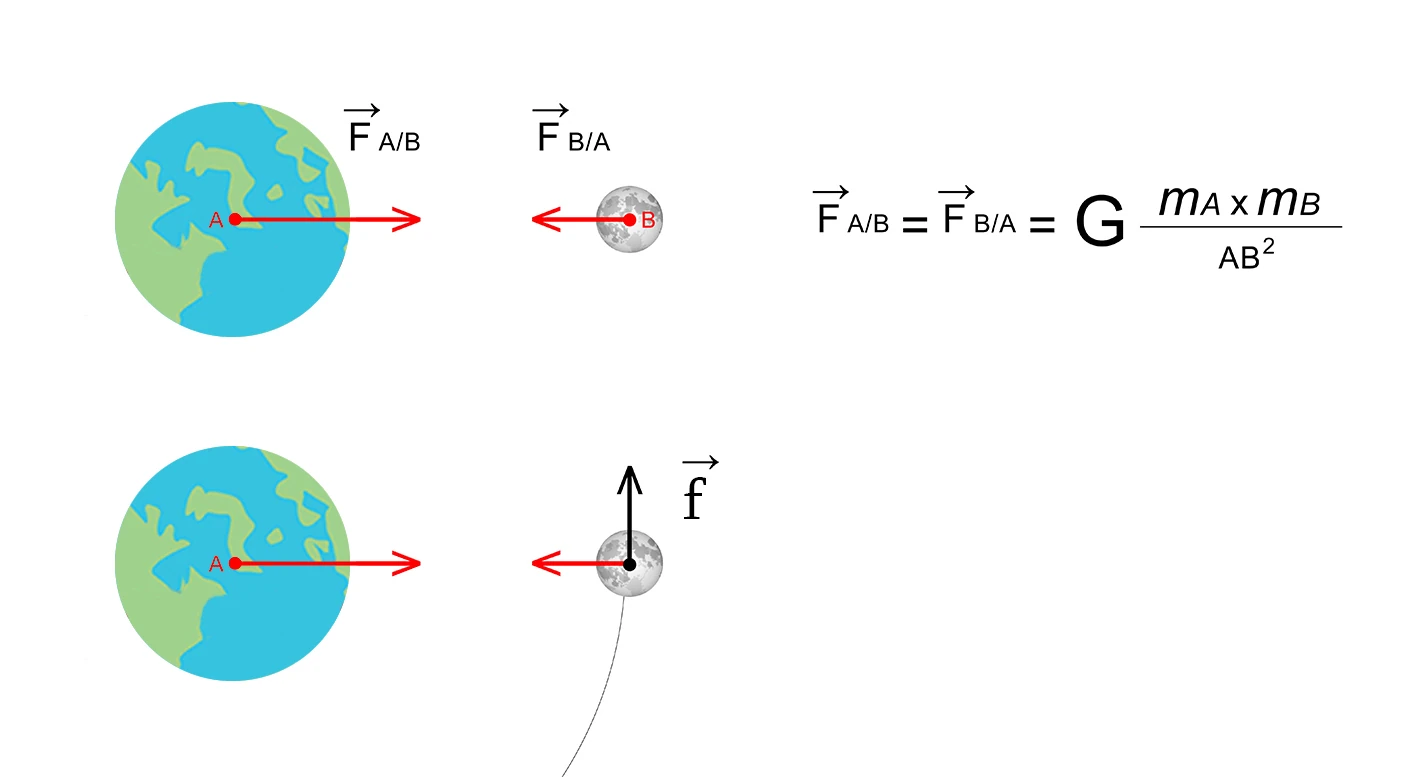
(vectorized by f in the diagram below, taking
the Moon’s orbit around the Earth as an example). That driving force is simply
omitted from their framework: and that is precisely where the shoe pinches.
If no semblance of an
answer regarding the origin of force f can be formulated, gravity cannot be
validated in the manner contemporary cosmology presents it. Consider, moreover,
that no instrument can directly detect it and no scientist can reproduce its
field in a laboratory setting. Of all the fundamental interactions, and
precisely because it most stubbornly eludes our understanding, this so-called
cohesive force remains one of the densest mysteries in present-day physics.
Consequently, we should not fear to admit that the lack of scientific rigor
surrounding this concept is hardly reassuring as to the quality of
institutional expertise, severely weakening the very pillars upon which its
authority rests. Still, ever more implausible speculations continue to take
center stage. Yet in truth, between the curvature of space-time and the
hypothetical subatomic particles of the quantum realm – the so-called
“gravitons” – we have not advanced a single inch. Why? Simply because the true
origin of this natural phenomenon remains unfathomable to modern scientific
dogma. Physicists still content themselves with explaining that the kinetics of
celestial bodies are merely the lingering remnant of a hypothetical primordial
explosion – the famous “Big Bang” – offered to the world by the Jesuit priest
Georges Lemaître (1894–1966) in the early twentieth
century.
Newtonian gravity
presents yet another critical hurdle: the notorious problem of unifying quantum
mechanics with general relativity. According to Carlo Rovelli, it is only by
excising the very concept of gravity from the equations that such a unification
becomes possible. Thus, we are forced to recognize that theoretical physics is
once again colliding with the limits of its own extravagances.
Once we accept that
mere theories are routinely taught as absolute truths, it becomes simpler to
admit that science has lost the very heart of its intrinsic beauty. The
glorious ages that forged its reputation are now behind it, and the torches
that once distinguished it from dogma now cast only a feeble light. Richard
Feynman (1918–1988), who received the Nobel Prize in Physics in 1965 for his
work on quantum electrodynamics, had no qualms about confessing: “Science is
the belief in the ignorance of experts.”
Even if the standard
model of astrophysics seems content with it, our grasp of the universe remains
juvenile, flawed, and visibly stitched together. Humankind will never
emancipate itself from its cosmic Stone Age if we continue building ever higher
upon the foundations of a “science” that has reached its limits – a framework
that belongs far more to speculative fantasy than to empirical theorem. It is a
stark fact: modern science has sunk into doctrinal systems it can no longer
shed. The university watchdogs, haloed in performative vanity, never miss an
opportunity to ridicule whatever lies beyond their narrow field of possibility.
Such a mentality will never spark the paradigm shift the scientific world so
desperately needs in order to evolve. Only on the day our inquiry aligns with
the primary principles at the source of creation will nature, perhaps, once
again reveal to us the true gears set in motion by the Regulator of this
magisterial clockwork.
•••••
Yet,
despite this consensus – infuriating though it may be – we must not slip into
extremism and dismiss every theory out of hand. For when such ideas stem not
from sterile mathematics alone, but from pure intelligence, certain among them
command our serious attention. Consider, for example, the somewhat enigmatic
concepts of dark energy and dark matter, which have set the scientific
community abuzz ever since Edwin Hubble’s observations in 1929. Since that
time, many astrophysicists have maintained that the expansion of our universe
is bound to a dynamic phenomenon – one both invisible and intrinsic to the very
fabric of space.
Thought to be
ninety-six percent empty, that space would, in truth, be anything but a void.
It would instead be permeated by an energetic essence – indescribable within
our tangible world, yet incessantly interacting with it. The vacuum would thus
be saturated with a kinetic essence, variable in density, which no one can yet
explain, measure, or reproduce. It is hardly impossible, then, that behind the
realm accessible to the senses lies a continuum of whose existence we remain
entirely ignorant. David Bohm (1917–1992), one of the founding fathers of
quantum physics, would scarcely contradict such a premise, having declared: “Space
is not empty. It is full. The universe is not separate from this cosmic sea of
energy.”
When evaluated in the
light of mainstream academic cosmology, several fundamental questions regarding
celestial mechanics remain strikingly unanswered. Here, in my view, are the
most pertinent:
·
What impulse drives
the Earth to rotate upon its own axis?
·
What force impels the
Earth to orbit the Sun?
·
What drives the
entire solar system to revolve around the center of our galaxy?
·
Why do the planets
orbit the Sun within a shared, coplanar disc?
·
Why do celestial
bodies rotate individually upon themselves?
·
Why can we predict
the movements and positions of the stars with such breathtaking temporal
precision?
·
Why do the Earth, the
Sun, the Moon, and the planets all assume the form of a sphere?
·
In accordance with
the principle of action and reaction, what manner of energy is consumed by the
perpetual motion of the stars?
·
Could the circular
motion of our celestial bodies be an equal and opposite reaction to the action
of this mysterious dark energy?
·
Might the enduring
mysteries surrounding universal gravitation be nothing less than the observable
effects of an invisible cause, nested within dark energy itself?
I believe the answers
lie at the very heart of this abstraction of the material world we call “dark
energy.” Yet, knowing that this realm is invisible, uncharted, and unexplored,
how are we to cross its threshold and truly grasp it? If modern science has
indeed reached its ultimate limits, where then do we turn?
•••••
At the age of 30, I laid hands upon a book
titled The Mystery of the Cathedrals and the Esoteric Interpretation of the
Hermetic Symbols of the Great Work, authored by Fulcanelli,
the famed French adept. That masterwork – a seminal landmark in alchemy –
proved to be the spark that ignited the powder of my research, offering as it
does precious keys to unlock the thresholds of the metaphysical realm of dark
energy.
To be
continued…