LUDOVIC NICOLAS STUDIO


An original thesis on space-time.
A JOURNEY INTO THE UNIVERSAL MATRIX

” Those with the courage to explore the weave and structure of the Cosmos, even where it differs profoundly from their wishes and prejudices, will penetrate its deepest mysteries. “
Carl Sagan (1934-1996)
INTRODUCTION
Published October 28,
2021
Author’s Note: This text was originally written
in French. Because certain nuances of semantics, etymology, and wordplay cannot
be fully captured in translation, I have chosen to keep the original French
terms in the text, underlined, to ensure the intended meaning remains precise.
First and foremost, I
wish to clarify that this thesis does not operate within an academic framework,
despite the automatic association most make with the term. If we follow the
definition provided by the Larousse dictionary: “a theoretical proposition,
opinion, or stance on a subject, the veracity of which one seeks to demonstrate”,
my work is entirely worthy of this title, without requiring the validation of
the establishment or any so-called ‘authority’. It is therefore with boundless
freedom of thought, without concession, and above all, without being
accountable to anyone, that we may explore – from every conceivable angle – the
subjects so dear to our polymathic enthusiasm. Thanks to this mindset, original
ideas have been able to flourish, blossom, and reveal themselves beyond the ‘plantation’
to which our curiosity is usually confined. To be invigorated by such openness
is a blessing, and it is my desire, without reserve, to share with you the rose of its quintessence.
•••••
The genesis of this
thesis dates back to the day my eyes first turned toward the sky, or, at the
very least, to the night I became conscious that the starry vault revolved
inexorably around a fixed point, much like a wheel around its axle.
Contemplating this grandiose spectacle, I could never have imagined that my
candid reflections on the mechanics of the cosmos would lead me to study a
constellation of disciplines, linking the heights of astronomy to the apparently
motionless spheres of mineralogy.
I turned, at first,
toward academic science, and despite some compelling discoveries in fields such
as quantum physics, I found many theories but very few theorems. Unlike a
theorem, a theory is based on speculation: it is a system of hypotheses
attempting to provide coherence to established principles of a philosophical or
mathematical order. In other words, a theory does not define immutable rules
and laws within reality. The contemporary scientific dogma relies, in effect,
on complex theories that cannot be demonstrated outside of a mathematical
language where equations are legion. And because these equations tend to feed
upon, entangle, and reflect one another in a closed loop, this linguistic
architecture is conducive to the wildest abstractions. Lines of equations are
certainly impressive to the common man, but, as René Guénon (1886–1951) pointed
out, they drift away from the sensible reality they claim to explain.
As “progress” unfolds,
these equations inevitably form an artificial body upon which scientists
continue to build their work, without ever questioning the actual solidity of
their foundations. Theoretical science may thus be compared to the Tower of
Pisa, whose structure stands admirably, yet threatens to collapse under the
weight of its own accumulated aberrations with every new advancement. And, as
surprising as it may seem, this clear realization escapes the actors of the
scientific community. At present, the most revealing example for contrasting
the synthetic complexity of mathematics with the rationality of the biological
environment is, without a doubt, string theory. Faced with such absurdities, a
question inevitably arises: why do we continue to spend so much time, energy,
and money on the study of spaces that bear no reciprocity to the metrology of
earthly life?
Before turning their
attention to realms invisible to the naked eye – whether it be the infinitely
large in astrophysics or the infinitely small in particle physics – perhaps the
scientific ‘elite’ would gain in authenticity if they paused to reflect more
seriously upon the manifestations of nature’s laws. It is paradoxical that at
the dawn of the 21st century, the true countenance of life remains one of the
most stubborn enigmas for a community that boasts of knowing the origins of our
cosmos and of constantly pushing back its frontiers. Perhaps it is time they
took a humbler tone and focused more on the essential: the causes – or perhaps
the Cause? – of life deserve far more attention than its effects. By seeking to
impress us with conceptual abstractions that, in the absolute, rest upon
nothing concrete, the prestidigitators of the universities mask their
incompetence and their blind spots regarding the elementary principles of
observable reality, all while subjugating their audience – students and
science-fiction enthusiasts alike – with a form of smoke and mirrors that is,
admittedly, fascinating.
The day academics
distance themselves from a theoretical science that leads nowhere, perhaps the
great enigmas of nature will finally be reconsidered within their lecture
halls. When that day arrives, science will once again be in symbiosis with the
fundamentals of universal physics. We might begin, for instance, by examining
the influence of lunar radiation on the perpendicular growth of a plant, or the
polarized and analogical relationship between the bronchi of a lung and the
branches of a tree: the former is sheltered from sunlight, inhaling oxygen and
exhaling carbon dioxide, while the latter absorbs carbon dioxide and releases
oxygen under the direct influence of the Sun.

At the beginning of the 20th century, Nikola
Tesla (1856–1943) – the visionary of invisible physics – had already warned us
of the mystifying drifts he perceived in theoretical science, embodied in his
day by Albert Einstein. In the American newspaper The New York Times, in
1931, he declared: “Einstein’s relativity work is a magnificent mathematical
garb which fascinates, dazzles and makes people blind to the underlying errors.
The theory is like a beggar clothed in purple whom ignorant people take for a
king... Its exponents are very brilliant men, but they are metaphysicists
rather than scientists.”
Indeed, the case of Albert Einstein
(1879–1955) is more than symptomatic of the intellectual morass in which we are
immersed. By ‘borrowing’ the broad outlines of his general theory of relativity
from the French physicist Henri Poincaré (1854–1912), we take very little risk
in asserting that the renown of this transgenerational icon of science stems
more from social engineering than from authentic genius. Having a plagiarist as
an idolized reference is a sign of the times, one that could not be more
revealing of the level of respectability that these institutions actually
deserve.
Lies do not merely concern the honesty and
morality of the pillars of our society; they also affect the technology we use
in our daily lives. At a time when electromagnetic waves connect all the
inhabitants of the Earth, the anachronism between the engineering of a mobile
phone and that of the internal combustion engine – the core technology of which
is approximately one hundred and seventy years old – is more than laughable.
This raises a question worth meditating upon in all sincerity: are the ‘scientific’
works upheld by the system the only ones that do not threaten its hegemony and
the sustainability of its economic model? The question is, at the very least,
worth exploring…
Take heed, then: if you wish to obtain a
degree from a prestigious university and build a career, it is best to avoid
certain subjects. Directing your research outside the framework imposed by
state-mandated conformism, especially when attacking the theories of the unthronable gods of the scientific pantheon, is an error
you must not commit. Despite manifest dead ends, it is unthinkable today to
challenge the structural beliefs of the Church of science. Refusing to bow down
before its idols would sign your excommunication, as well as the loss of your
credibility and respectability.
Since I have nothing to lose, nothing to
gain, and nothing to prove, it is easier for me to shed light on the frivolity
of ‘extraterrestrial’ physics concerning the primary focus of this study: the
revolutions of the celestial bodies above our heads. Although astrophysicists
remain light-years away from uncovering the mechanics underlying these
revolutions, they persist – anchored in the dogmas of their education – in
seeking to explain this phenomenon through Isaac Newton’s (1642–1726) universal
law of gravitation. While the equation of this theory certainly allows for the
quantification of an object’s fall to Earth and provides a mathematical
solution to account for the equilibrium between two celestial bodies, it fails
to specify the cause of their movement, which is, moreover, consistent. Ever
since the former president of the Royal Society pronounced himself on the law
of gravity, no member of the establishment has sought to elaborate, with the
seriousness that the scientific method would demand, on the cause of the
rotational force (vectorized as f in the illustration below, taking the Moon’s
orbital course around the Earth’s center as an example). This force, to use
current nomenclature, is never taken into account: this is precisely where the
shoe pinches.
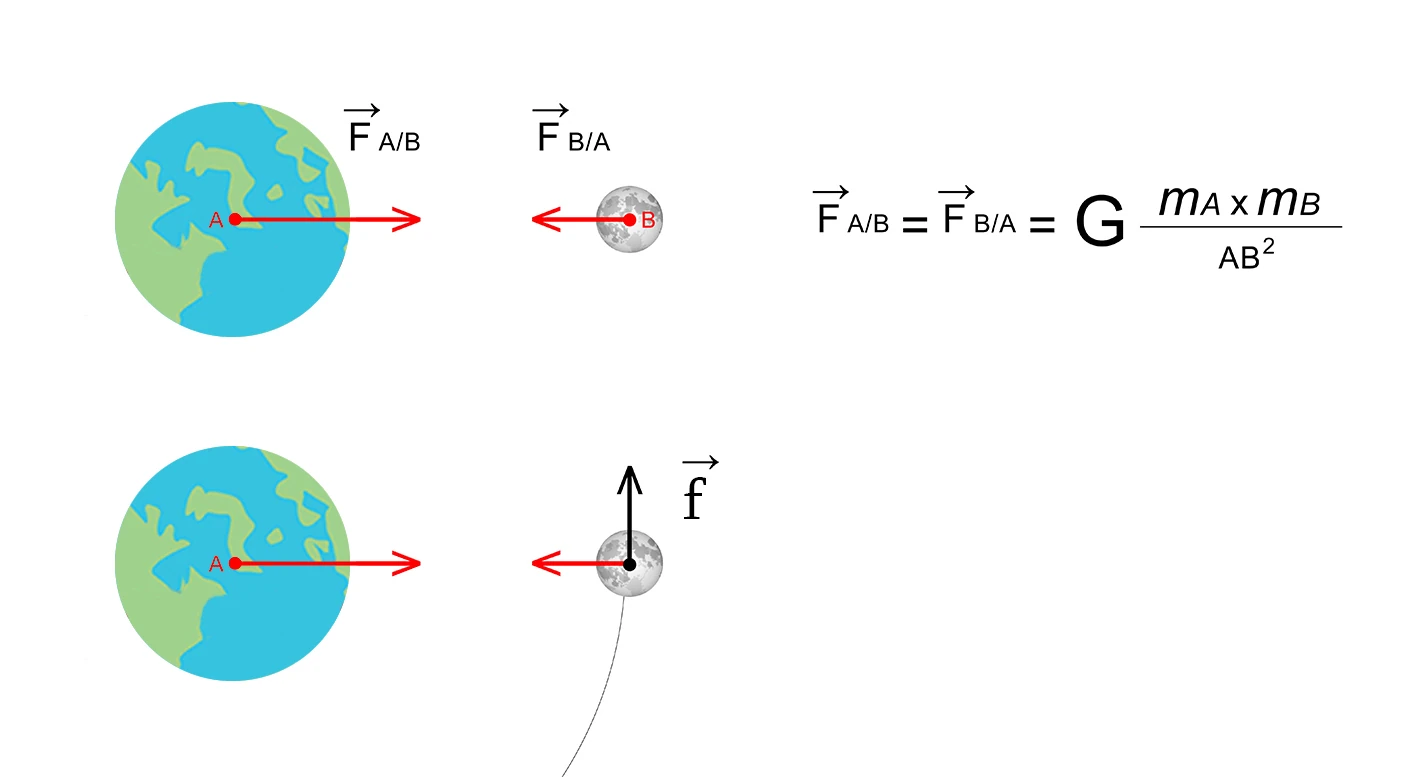
If no explanation for the origin of force f
can be formulated, gravity cannot be validated as it is presented by
contemporary cosmology. Let us add that no instrument can detect it and no
scientist can reproduce its field in a laboratory. Of all the fundamental
interactions, and precisely because it eludes our understanding the most, this
so-called ‘cohesive force’ remains one of the deepest mysteries in modern
physics. Consequently, one should not fear to acknowledge that the lack of
scientific rigor surrounding this concept is hardly reassuring regarding the
quality of the expertise involved, and that it weakens the pillars upon which
its reputation rests. Despite everything, speculations – each more implausible
than the last – continue to be put forward on the scientific stage. But in
truth, between the theory of space-time curvature and the hypothetical
subatomic particles of the quantum world known as “gravitons,” we have not
advanced by an iota. Why? Simply because the origin of this natural phenomenon
remains unfathomable to the science of our peers. Physicists are still content
to explain that the kinetics of celestial bodies are the reminiscence of a
hypothetical explosion at the origin of our universe – the nebulous ‘Big Bang’
– presented to the world by the Jesuit Georges Lemaître
(1894–1966) at the beginning of the 20th century.
Newtonian gravity poses yet another problem:
that of unifying quantum mechanics with the theory of general relativity.
According to Carlo Rovelli, it is only by removing the very notion of gravity
from the equations that this unification becomes possible. One must therefore
acknowledge that theoretical physics is once again colliding with the limits of
its own extravagances.
Once one accepts that certain theories are
currently taught as absolute truths, it becomes easier to admit that science
has lost the heart of its intrinsic beauty. Its glorious days, which
established its reputation, are now behind it, and the torches that once
distinguished it from religion now cast but a feeble light. Richard Feynman
(1918–1988), Nobel laureate in physics in 1965 for his work on the development
of quantum electrodynamics, had no qualms in admitting that: “Science is the
belief in the ignorance of experts.”
Even if the standard model of astrophysics
seems satisfied with it, our apprehension of the universe remains juvenile,
incorrect, and transparently contrived. Mankind will never be able to
emancipate itself from its cosmic stone age if we persist in building, ever
higher, upon the foundations of a ‘science’ that has demonstrated its limits
and that pertains more to fantastic theory than to empirical theorem. It is a
fact: science has sunk into doctrinal systems from which it struggles to free
itself. The academic gatekeepers, cloaked in an overt vanity, never miss an
opportunity to ridicule anything that does not originate from their own field
of possibilities. Such a mentality will never be able to initiate the paradigm
shift the scientific world needs in order to evolve. The day our approach
merges with the principles at the source of creation, perhaps nature will once
again reveal to us the gears used by the Architect of this masterful clock.
•••••
Despite
this consensus, however annoying it may be, one should certainly not fall into
extremism and reject all theories out of hand; for, when they emanate not from
mathematics alone, but from pure intelligence, some are worthy of interest. We
are thinking in particular of the somewhat obscure notions of dark energy and
dark matter, which have kept the scientific community in a ferment since the
observations of Edwin Hubble in 1929. Since then, many astrophysicists have
estimated that the expansion of our universe is linked to a dynamic, invisible
phenomenon that is intrinsic to space.
Considered to be 96% empty, this space is, in
fact, not empty at all; it is filled with an energetic essence, indescribable
in our tangible world, yet interacting with it nonetheless. Space would thus be
saturated with a kinetic essence, of varying density, which no one can
currently explain, measure, or reproduce. It is therefore not impossible that
behind the world accessible to the senses lies a continuum of whose existence
we are entirely ignorant. And David Bohm (1917–1992), one of the fathers of quantum
physics, would certainly not contradict us, having declared: “Space is not
empty, it is full. The universe is not separate from this cosmic sea of energy.”
In the eyes of academic cosmology, several
fundamental questions regarding celestial mechanics remain unanswered. In my
view, these are the most pertinent:
·
What causes the Earth to rotate on its axis?
·
What causes the Earth to orbit the Sun?
·
What causes the solar system to revolve
around the center of the galaxy?
·
Why do the planets orbit the Sun on a common
plane?
·
Why do the planets rotate on their own axes?
·
Why is it possible to predict the movement
and position of celestial bodies with such great temporal precision?
·
Why do the Earth, the Sun, the Moon, and all
the planets share the shape of a sphere?
·
Following the principle of action and
reaction, what type of energy is consumed by the movement of celestial bodies?
·
Is it possible that the circular movement of
our celestial bodies is a reaction to the action of this mysterious dark
energy?
·
Might the mysteries surrounding the mechanics
of universal gravitation be the observable effects of an invisible cause,
nested within dark energy?
I believe the answers lie at the heart of
this abstraction of the material world that we call “dark energy.” But, knowing
that this space is invisible, unknown, and unexplored, how can we unlock its
doors and apprehend it? If modern science has indeed reached its limits, where
should we turn?
•••••
At the age of 30, I
came across a work titled Le Mystère des Cathédrales et l’Interprétation ésotérique des symboles hermétiques du grand œuvre (The
Mystery of the Cathedrals and the Esoteric Interpretation of the Hermetic
Symbols of the Great Work), written by Fulcanelli, the renowned French
adept. This book, a classic and essential text in the field of alchemy, was the
spark that ignited my research, as it offers invaluable keys for unlocking the
doors to the metaphysical realm of dark energy.
However, access to these keys was hidden
behind the artistic smoke screen of an “imagistic,” cryptographic, and
cabalistic language. Despite my inability to pin down the perfume of this
language, the mysterious essence of this Art permeated my mind from the very
first paragraphs written by the master. This vibration was not foreign to me;
its aroma had resonated significantly, naturally, and intuitively in my inner
self since my earliest childhood. I was then far from imagining that this
linguistic axiom – the Cabale – actually existed outside of my secret garden.
To help you understand what this entails, here is one of the best definitions
of the Cabale (from the Latin cabbalus): “It
is a language of a hieroglyphic nature, playing on every register of
expression: images, words, letters, numbers, sounds, colors, forms, weights,
etc., as well as on secret conventions, of which metaphor and emblematic
rebuses are the most widespread type. It has no fixed or particular form, and
depends solely on the culture and imagination of those who employ it.”
Today,
unfortunately, the only “kabbale” known to Western
culture –atrophied by
speculative Masonry – appeared
in the rabbinic tradition in 13th century Spain with the Zohar, or “Book
of Splendor.” Contrary to the proselytizing consensus, whether one writes “kabbale,” “kabbalah,” or even “qabbalah”
– the better to serve a more effective
mystification – it is not an
original, isolated, or predominant movement, but merely the reflection cast by
Jewish mysticism upon a tradition that preceded it. Moreover, the word “kabbale” is not of Hebrew origin, as it draws its etymology
from the Greek kabbalès. This is why, in order
to avoid the trap of homophony, to refrain from promoting the inanities of
popular culture, and to affirm the universality of its affiliation, scholars
prefer to use the term “Hermetic Cabale” (in honor of the mythical figure of
Hermes-Trismegistus).
In any case, whether cabbalus
in Latin or kabbalès in Greek, both terms
designate the emblematic animal of knowledge since the highest Antiquity: the
horse. Consequently, the semantic relationship between between
“cabaliste” (cabalist – a person who
uses the Cabale) and “cavalier” (horseman) becomes as
clear, coherent, and justified as can be when viewed through the lens of
initiatory tales – often chivalric in nature – such as those written by
Chrétien de Troyes following the first Crusades and the discovery of Eastern
folklore. Indeed, from the heights of the astronomical sympathies we share down
here, how can one contemplate the story of the Knights of the Round Table, of
King Arthur, and of the quest for the Holy Grail – the chalice of chalices – from
any angle other than the Hermetic prism? It is no coincidence (hasard is a term of Persian origin which translates
to “the hand of God”) that the hero’s journey, always embodied by the
adventures of a valiant knight (the expression of the Donum Dei), is so
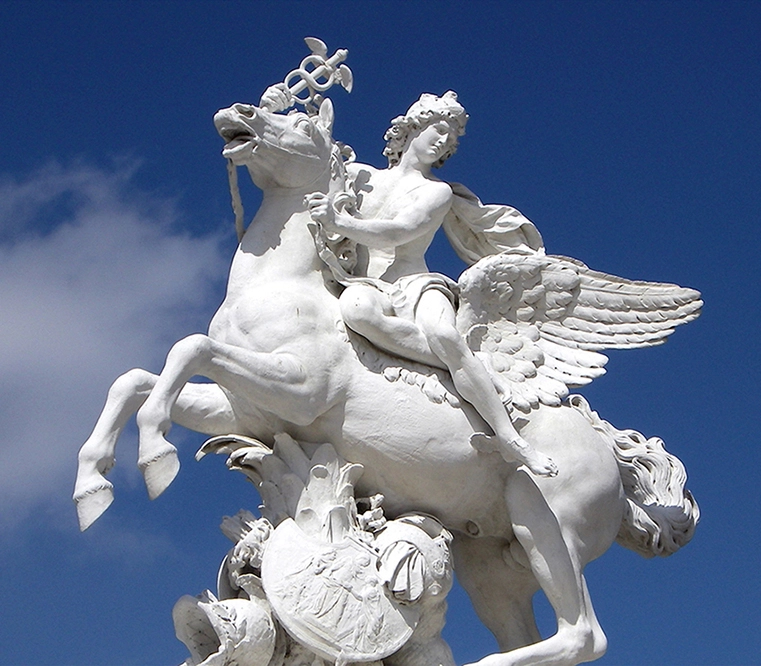
emblematic of a tradition dating back to the dawn of time: the mount of Pegasus
was already being ridden beneath the starry dome of the Chaldeo-Egyptian
priestly castes.
To understand how the spirit of Hermetic
Cabale is articulated, let us take a literary example with the word “occult”
(this choice is not trivial, as it will serve to distance your
thinking from the association that vulgar culture makes with demonic
practices). The structure of this word breaks down into “o,” “c,” and “cult.”
For a Hermetist, the “o” is the hieroglyphic sign of
the Sun, and “c,” in its curvature, that of the Moon; consequently, “occult”
emphasizes the cult dedicated to these two luminaries. From an operative
standpoint, this reading resonates with the definition given by the Larousse
dictionary: “That which acts, or is done in a secret manner, whose goals
remain unknown, hidden: an occult influence.”
Before the universality of Hermetic Cabale
was led astray by the Kabbale, and before the
School of Fine Arts feigned amnesia, all Artists (worthy of this capital
letter) utilized it in their works to perfect beauty through its finest arcanas, right up until the end of the 19th century. When I
fully realized that these aesthetes used their creations as an initiatory
canvas, my feet no longer touched the ground for several days. This epiphany
bordered on illumination.
Indeed, the impact of such a practice on my
relationship with Art, both in the interpretation of the concept and in the
exegesis of culture in general, was an unprecedented revelation in my life; for
I could never have imagined that my natural predisposition to find analogies
between things that, a priori, had none, would one day prove to be one
of my greatest assets in my quest for the absolute. What I had always taken for
a curse – a psychological pathology – now appeared to me as a gift that had to
be cultivated. A sign had just been sent to me, and I took its message with the
utmost consideration: Hermeticism dwelt within me.
The caprices surrounding destiny are
decidedly more than romantic, as this ancestral tradition had the potential to
be an inexhaustible source of inspiration and to channel my most metaphysical
musings. I knew then, without a shadow of a doubt, that the doors to the
mysterious realm of the invisible were no longer sealed forever.
At the dawn of my 33rd year, from the
sublunary world, I turned my gaze toward the rising Sun.
•••••
Before continuing, it seems important to open
a brief parenthesis to explain why Hermetic philosophy and its operative
applications – alchemy, magic, and astrology – are no longer respected and
valued as they once were by the science of our ancestors.
Assuredly, the mere mention of any of them is
enough to trigger the sneers of our contemporaries. This mentality, however
contemptuous it may be, was spearheaded by a school of thought born in the 18th
century, which dared, without any shame, to pervert the meaning and use of the
word “philosophy.” Let us be very clear on this subject: authentic philosophy
has nothing in common with the “philosophy” of the Enlightenment; the
sociological, humanistic, and naturalistic speculations of the latter were
never the primary concerns of the philosophers of Antiquity such as Zoroaster
(c. 6th century BC), Aristotle (384–322 BC), or Confucius (551–479 BC). Unlike
the contributors to the Encyclopédie and their Germanic counterparts,
true philosophers were driven by a sincere quest for spirituality, wisdom, and
truth.
Moreover, why not
have called their intellectual movement “la philosophie
de la Lumière” (the philosophy of the Light) instead of “la philosophie des
Lumières” (the philosophy of Lights), which is the true
translation of “the philosophy of enlightenment”)? Using the plural marks a diabolical intention to fragment that which
cannot be fragmented. Through this manipulation – a priori innocuous –
truth
no longer exists as such, but becomes falsely multiple and variable, depending
on one’s own orientation. Therefore, let us not be blinded by the worldly
hypocrisy of a certain salon bourgeoisie, and let us not lose sight of the fact
that the authentic definition of philosophy is, in its etymological excellence,
“the love of wisdom.” Pythagoras (6th century BC)
specified: “I am a philosopher, not someone who claims to
possess wisdom, but a man who strives toward it.”
Attributing a revised architecture to words, in order to divert the power of
their egregores and destroy the traditional heritage of our past, is part of
the perversions that have been used and financed by a dominating ‘elite’ with
the objective of defending and securing the permanence of their power.
Under the revolutionary impulse of the Age of
Enlightenment – wrongly attributed to the people by
our history books – society
entered an unbridled and lethal obscurantism. Everything linked to the beliefs
of the previous culture was to disappear, to vanish, to be forgotten, and, as a
symbol, our majestic cathedrals were ransacked.
The Jacobin mentality, perfected by
fallacious initiations into which opportunists of every stripe have rushed,
dealt the coup de grâce to the sacred idea by
imposing the abject notion that man could henceforth be considered the equal of
God. Such a doctrine constitutes a blasphemy in light of Chapter 6, verse 19,
of the First Epistle to the Corinthians (a book of the New Testament), written
by the Apostle Paul: “Do you not know that your body is a temple of the Holy
Spirit within you, whom you have from God, and that you are not your own?” From
then on, the Gnostic teaching of divine transcendence had no place in the
temple. The operative was thus deviously replaced by the speculative: why
strive to look at the heavens and their starry planisphere, since in the eyes
of these merchants – who have never truly left the temple – there is no longer
any truth outside that of the all-seeing eye?
Since the advent of materialist, naturalist,
and nominalist Illuminism, everything that cannot be demonstrated, qualified,
or measured has ceased to exist. Like Saint Thomas, the science of the
Encyclopedists now believes only in what it sees, and Hermetic doctrines were
definitively relegated to the rank of superstition. Let us have the courage to
name things: this triumphant rationalism is at the root of the immobilism and
conformism that paralyze today’s scientific community. René Guénon (1886–1951)
rightly pointed this out: “Rationalism is essentially defined by the belief
in the supremacy of reason, proclaimed as a true dogma, implying the denial of
pure intellectual intuition, which logically leads to the exclusion of all true
metaphysical knowledge.”
Parenthesis closed, let us return to a more
vertical approach to our considerations.
•••••
Since societies have become initiatory in
name only, the only way to find the sought-after grace is to follow, in
complete independence, a personal path. To do this, it is essential to study
the mysteries of Hermetic philosophy through its texts.
For an occultist, this task is no small feat,
as this literature is teeming with false appearances. If you were unaware that
initiates always veiled their writings using Hermetic Cabale in order to ward
off the envious, their grimoires would be of no use to you. Many aspirants have
thus been ill-inspired. Michael Sendivogius, the famous 17th century alchemist,
better known as The Cosmopolite, already warned us: “If Hermes, the father
of Philosophers, were to be resurrected today, along with the subtle Geber and
the profound Raymond Lully, they would not be regarded as philosophers by our
vulgar chymists, who would scarcely deign to count
them among their disciples, because they would be ignorant of the manner in
which to proceed with all these distillations, circulations, calcinations, and
all those innumerable operations that our vulgar chymists
have invented through a misunderstanding of the allegorical writings of these
Philosophers.”
To this, one must add that after the tsunami
of Illuminism, between the 18th and 19th centuries, false prophets took the
liberty, in order to subjugate their audience, of ‘enriching’ the heritage of
Hermes with texts plucked straight from their own imagination. Knowing that it
is necessary to bypass these deceits, the core of our exegesis must therefore
focus on the texts of the Eastern tradition, which were likely translated into
Greek following the conquests of Alexander the Great in the 4th century BC.
When the Macedonian seized Egypt and
installed one of his generals as the new pharaoh), the horizon of this
ancestral land was revived by the flamboyant light of a new beacon. While, most
of the time, the annexation of a land tolls the knell for its local culture,
this was not the case with the line of Ptolemaic pharaohs. Rather than
destroying to impose their own vision, the new legislators rebuilt the country
to restore its former splendor. Under the impetus of Aristotelian philosophy,
the Greco-Hellenistic culture blended with the millenary teachings of the
Egyptian mystery schools and the Mesopotamian world. Whether it came from
Persian sages, like Zoroaster (whose name means “the golden star” or “the
splendor of the Sun”), or from the priestly caste officiating in temples
situated along the banks of the Nile, the initiatory teaching received by the
Greeks was certainly not new; it is often recalled that Thales of Miletus (c.
625–585 BC), Pythagoras (c. 570–495 BC), and Plato (428–347 BC) had already
greatly benefited from it in their time. The city of Alexandria, christened
with the name of its conqueror, then became a place of encounter and exchange
highly prized by all experts in the Mediterranean basin regarding Hermeticism
and occultism. In this prodigious hearth of scholars, scientists, and magi,
Gnosis (gnosis translates from Greek as “knowledge” and proceeds from
the desire to know God and His secrets) was incredibly fruitful. Unfortunately
for the salvation of humanity, most of the manuscripts produced during this
effervescence seem to have perished in the flames of the memorable library.
This ultimate act of barbarism against the heritage of our peers was not merely
the witness of a change in mentality: it marked with a red-hot iron our
civilization’s entry under the temporal yoke of the Roman Empire for the
millennia to come.
Even if, today, the power of Rome is no
longer as manifest, rest assured that its influence has spanned the ages: after
having conquered lands by the sword, the Catholic Church – the direct heir of
the Empire – seized souls by the crucifix.
Fortunately for the tradition, 17 manuscripts
stemming from Egyptian philosophy of the Ptolemaic era resurfaced thanks to the
translations of Marsilio Ficino (1433–1499), the unavoidable luminary of the
Italian Renaissance. Collected under the title Corpus Hermeticum,
these texts are considered the foundations of Hermeticism; on the path of the
sages, their radiant philosophy acts as a natural prism, decomposing the light
of divine revelation into the following themes:
·
The order of the cosmos
·
Unity (the omniscience, omnipotence, and
omnipresence of the Eternal)
·
The Sun
·
The demiurge
·
The cohesion of the spheres
·
The fusion of opposites and polarity
·
The visible and the invisible
·
Truth and the illusion of our reality
·
Creation through the circular movement of
Unity
·
The Nous and the creative will
·
Time, space, and matter
·
Body, soul, and spirit
·
The good, the beautiful, the right, and the
just
·
Vices and virtues
·
Creation as an Art and the notion of harmony
·
The Ogdoad
·
Intelligence and its relationship to the man-god
·
The 12/10 (or
6/5) ratio
·
The zodiac and astrology
Clearly, the mention of astrology in this
list may come as a surprise; yet, you should know that, despite the fate
currently reserved for it, the magi-initiates of Antiquity always made it the
cornerstone of all their sciences. Together with magic and alchemy, this
esotericism brings together, under the term “theurgy,” the 3
operative paths of Hermetic philosophy. They form a harmonious and inseparable
whole. It is therefore highly unlikely that an alchemist could define himself
as such without having been initiated into the magisteria
of the other two disciplines.
The importance of this trinity was very well
understood by the Greeks, as it is suggested in the name of the god associated
with the father of philosophers: the well-named Hermes Trismegistus. Indeed,
beyond the commonly accepted translation of “Trismegistus” as “the
thrice-greatest,” one can quite reasonably, through the lens of phonetics,
propose another level of reading: “the 3 magisteria.” This
interpretation resonates with the 3 kingdoms (mineral, vegetable, and animal), the 3 planes
of existence (material, spiritual, and divine), the 3
ontological layers (body, soul, and spirit), or even the 3
alchemical principles (salt, sulfur, and mercury).
Even if the trinitarian doctrine of unity has
traversed time via the pantheon of the Greek world, its historical origin is
indeed Egyptian. The splendor of this testament is found on the Giza plateau,
where the 3
pyramids remind the intellect of the observer that the divine trinity is
atemporal, immortal, and indestructible. How can one not be captivated by the
majesty, the grandeur, and the genius of the civilization that built them? The
geometric, astronomical, and energetic properties implicit in these volumes
reveal to all – but especially to those who know how to see beyond appearances
– the beauty of a thought that ours has never equaled.
Coming from the dawn of time, the heritage of
this intelligence is also personified in the attributes of the messenger of the
Egyptian gods, Djehuty-Thoth (tradition has always
taken pleasure in identifying him with Hermes Trismegistus). The pen of the
late Jean Phaure (1928–2002) thus described
Djehuty-Thoth: “He is the scribe of the Divine Ennead, the brush with which
the god of the universe writes, the creator of languages, the great magician of
the spheres who presides over the original creation to call the world into
existence through the Word, alongside Ptah. He is, above all, the one who
presides over the order of the world, the great calculator, the master of the
cycles of time.”
It is important to clarify that, in the
Egyptian theogony, Djehuty-Thoth was not considered a
god in the literal sense, but rather a neter
(phonetically very close to “nature”); that is to say, the anthropomorphic
representation of a Force, an action of divine immanence in the manifested
world, a kind of hypostasis or an aeon, as the
Gnostics liked to define it. It would be difficult to be more generous than by
offering you the key that provides access to the 12 verses of the Emerald Tablet (Tabula Smaragdina in Latin or Lawḥ
al-zumurrudh in Arabic), upon which the entire
firmament of Hermetic philosophy is synthesized. All occultists versed in the
history of religions have been passionate about these lines engraved on an
emerald. Depending on their culture and era, the most learned among them have
produced a myriad of translations, more or less faithful to the oldest recorded
version, written in Arabic in the 9th century: the appendix to the Book of
the Secret of Creation (Kitâb sirr al-Halîka). From the perspective
of the tradition, this Arabic filiation is not devoid of meaning, since the
Arab conquerors dislodged the Byzantines from Alexandria in the 7th century and
became, by necessity, the active vectors of initiatory transmission.
Personally, I prefer Hortulain’s
14th century translation of the Latin Vulgate:
I.
It is true without lying, certain and very
true
II.
What is below, is what is above: and what is
above, is what is below, to work the miracles of one thing.
III.
And as all things have been, and have come
from one, through the mediation of
one: so, all things have been born of this
one thing, by adaptation.
IV.
The Sun is its father, the Moon is its
mother, the wind carries it in its womb; The earth is his nurse.
V.
The father of all the Telesme
of everyone is here. His Force or Power is whole,
VI.
If it is converted to land.
VII.
Thou shalt separate the earth from the Fire,
the subtle from the thick gently, with great industry.
VIII.
He ascends from earth to heaven, and again he
descends to earth, and he receives the
Force of higher and lower things. Thou shalt have by this means the glory
of all; and for this all darkness will flee from you.
IX.
It is the
strong Force of all force: for it will overcome every subtle thing, and
penetrate every solid thing.
X.
Thus, the world was created.
XI.
From this will come admirable adaptations,
the means of which is here.
XII.
That’s why I was called Hermes-Trismegistus,
having the 3 parts of everyone’s Philosophy. What I have
said of the operation of the Sun is
accomplished, & completed.
These verses have a curious resonance with
the prologue to St. John’s Gospel, which is quoted below:
I. In the
beginning was the Word (the Logos), and the Word was with God, and the
Word was God
II. The
Word was with God in the beginning.
III. All
things were created by him, and apart from him not one thing was created that
has been created.
IV. In him
was life, and the life was the light of humanity;
V. And The
Light shines on in the darkness, and the darkness did not overcome it.
VI. A man
came, sent from God, whose name was John.
VII. This
one came for a witness, in order that he could testify about The Light,
so that all would believe through him.
VIII.
hat one was not the light, but came in order
that he could testify about the light.
IX. The
Word was the true Light, which enlightens every man by coming into
the world.
X. He was
in the world, through whom the world was made, but the world did not recognize
him.
Indeed, the similarities between the two
texts are more than striking. Consequently, the scribes of the Catholic Church
likely drew inspiration from the wisdom contained in the breath of Hermetic
texts. In the creation of the “Holy Scriptures,” the use of earlier manuscripts
by the Church Fathers is confirmed on two counts. On one hand, the Gospel of
John bears an uncanny resemblance to the Gnostic writings of Cerinthus, dating
from the 1st century AD. On the other hand, the Apocalypse (apokalypsis
translates from the Greek as “revelation”), attributed to Saint John, is an
assembly of a myriad of sacred texts, such as the Book of Enoch or the Book of
Ezekiel.
In a sense, the desire to incorporate
ancestral knowledge into the message of Christ’s favorite apostle (always clad
in a green cloak in iconography) indicates that Catholicism was shaped by
pre-existing doctrines. Furthermore, let us not forget that before the
invention of the printing press in the 15th century, falsifying a manuscript was
child’s play; those thirsty for religious supremacy practiced this art with the
success we know. For instance, regarding the Old Testament, exegetes are aware
that the Ten Commandments, supposedly delivered to Moses by God on Mount Sinai,
are merely a retreading of Chapter 125 of the Egyptian Book of the Dead. Like
it or not, Hebrew theology, much like Christian theology, is but a variation of
the Gnostic precepts of the neter with the
single green eye: Horus, the Egyptian light-bearer. There is nothing new under
the Sun; the Egyptians themselves had recycled earlier knowledge. This is why
the biblical texts, the Pentateuch, and the canonical Gospels can never be
considered historical truths or indisputable theological references.
Nevertheless, even when altered, sacred
literature still conceals many initiatory treasures that would be well worth
examining, for the theosophical syncretism found in all texts of a culture or
civilization irremediably suggests a common origin, a kind of primordial
tradition, as René Guénon (1886–1951) liked to define it.
That being said, let us return to the verses
of the Emerald Tablet.
•••••
In these
verses, what first strikes our attention is the entirely innovative principle
that a Force – the “Word” in the prologue of Saint John – is linked
to the creation of the world, to the action of the Sun (symbol of light), and
to the mediation of Unity. This ancestral conception of the origin of matter is
remarkably close to the declaration made by Max Planck (1858–1947), the 1919
Nobel laureate in physics: “All matter originates and exists only by virtue
of a force which brings the particle of an atom to vibration and holds this
most minute solar system of the atom together. We must assume behind this force
the existence of a conscious and intelligent Mind. This Mind is the matrix of
all matter.” Upon realizing that the initiates of Antiquity had already
understood what men of the 20th century are only just beginning to discover,
one cannot help but be astounded. And let us make no mistake: it is indeed the
existence of God that is suggested by this luminary of the scientific
community.
The
reality of inaccessible, indescribable, and incommensurable fields can no
longer be viewed as a mere device of science-fiction films or as the rambling
of sages from the East. By systematically referencing the films of George Lucas
(born 1944) whenever the idea of a Force is mentioned, our generation’s culture
fails to realize that the description given by Master Yoda to his young
apprentice, Luke Skywalker –
for whom “the Light that walks in
the sky” is the Sun – is in every respect similar to that of the
tradition of the magi: “My ally is the Force, and a powerful ally it is.
Life creates it, makes it grow. Its energy surrounds us and binds us. Luminous
beings are we, not this crude matter. You must feel the Force around you, here,
between you, me, the tree, the rock, everywhere.” To master the Force is,
as you have guessed, to attain the rank of knight... After long centuries of
religious ineptitude, adogmatic science and popular
culture can finally be reconciled on the fertile ground of Gnostic clairvoyance.
Before continuing,
it is useful to specify that the creators of Star Wars were erudite
artists. Indeed, “Luke” derives from the Latin root lucere
and the Proto-Indo-European root leuk, meaning
“light,” “clarity,” or “radiant energy,” while “Jedi” is a phonetic borrowing
from the first syllable of… Djehuty-Thoth.
Thanks to
these revelations regarding the Force – which assimilates creation to the will
of an intelligent consciousness or a demiurge – the 12 verses of the Emerald Tablet guide the
consciousness of each individual toward the primacy and exactitude of the
vision held by the disciples of Hermes. Where our peers limit themselves to a
science of effects, purely material in nature, our ancestors already surpassed
the intelligible world to focus directly on the cause of manifestation:
spiritual, existing beyond time and space.
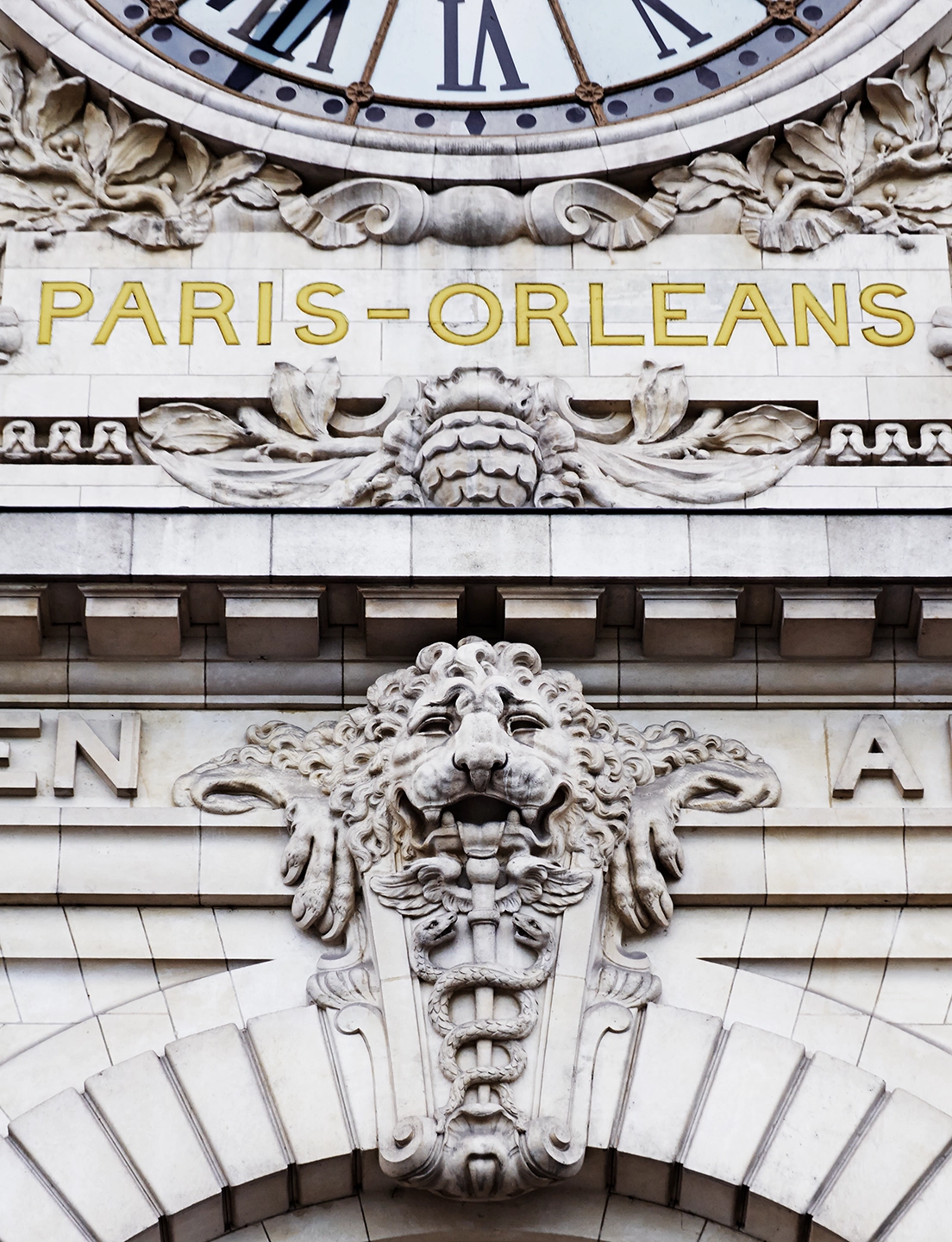
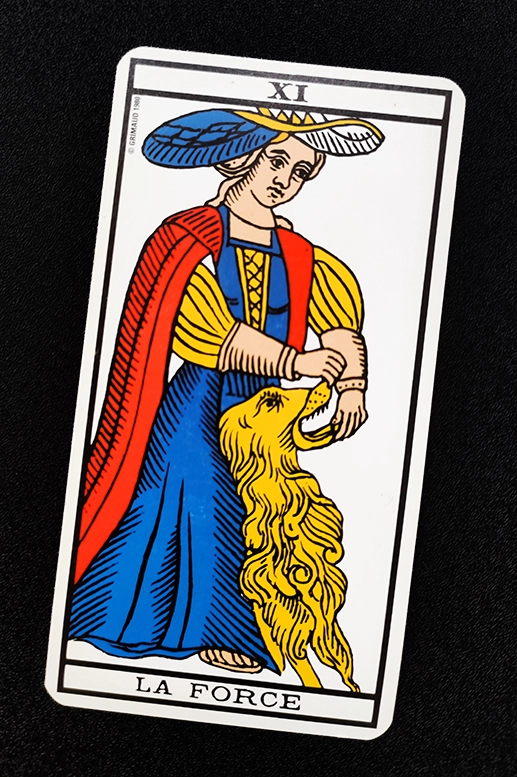
Adepts
of Hermetic philosophy have always compared the properties of the spiritual
essence, which precedes matter, to those of an ocean, for its “water” fills the
“void” (vidyā translates as “knowledge”
in Sanskrit) just as it would any vessel. This ocean echoes the cosmic sea of
dark energy to which David Bohm also alluded. Since the homophone of of “mer” (sea), “mère”
(mother), comes from “mater” in latin, we can
weave interesting semantic links between “mer,”
“mère,” “mercure,”
(Mercury – the avatar of Hermes Trismegistus among the Latins), “matière”
(matter), “matrice” (matrix/ womb), and
“Marie” (Mary), which is an anagram of “aimer,” “to
love” in english.
If this
invisible matrix is the origin of all manifestation, the assumption that it is “virgin”
stands to reason. The emblem of the Black Virgin (black, as opposed to the
synthesis of the 6 colors of the visible spectrum, here
expresses the absence of light) just like that of the Virgin Mary, then becomes
more explicit from the perspective of theosophy, since the Blessed Virgin, the
Queen Mother, “la mère divine” (the divine sea), is the ordinary
figuration of the philosophers’ mercury. Curiously, the anagram of “énergie noire” (dark energy) is “reine ignorée” (ignored
queen), which reminds us of verse 1:5 of the Song of Songs, likely born from
the love between King Solomon and the Queen of Sheba: “I am black, but I am
beautiful...”
In the
12th century, in his work Secret Book Concerning the Hidden Art and the
Philosopher’s Stone, the alchemist Artephius presented the water of the
sages in this way: “O how precious and magnificent is this water! For
without it, the work could not be perfected: it is therefore called the vessel
of nature, the womb, the matrix, the receptacle of the tincture, the earth and
its nurse; it is the fountain in which the king and the queen wash, and the
mother who must be placed and sealed upon the womb of her child, who is the
Sun.” Are you beginning to understand how the Kabbalists deliberately
obscured the trails leading back to the primordial ocean through the use of a
willfully convoluted lexicon, in order to define a single thing, which is, in
this instance, the uniqueness of matter: the materia
prima?
In the Corpus Hermeticum,
verse 16 of an excerpt from a discourse between Hermes and Tat states: “Everything
that exists is in motion; only non-being is immobile.” Unity, as a
preliminary state to divine manifestation, could then be imagined as energy in
the form of standing waves; when this energy is vectorized, the whole is set in
motion to create space, time, and, consequently, matter. The universal matrix
would thus be born from the rupture of the spatial equilibrium of unity: this
first impulse would be the “Force strong of all forces,” its Spiritus Mundi,
and its Holy Spirit. This would be the passage from the Ain Soph to the Ain
Soph Aur in the Tree of Life of the Hebrew Kabbalah.
A seasoned Kabbalist would decompose “Saint”
from “Saint-Esprit” (Holy Spirit) into 3 parts: “s,” “ain,”
and “t.” The silent “t,” by its cross-shaped trace, expresses the center. “Ain”,
or Ayn in Hebrew, designates the principle preceding matter, defining
both the abyss and non-existence; it resonates phonetically with “un”
(“one”), the digit of unity. Finally, the “s” is the letter of manifestation,
for its form undulates like the graphical representation of a pulse. In other
words, a saint is a person whose vibratory signature resonates with the first
impulse emanating from the center of Unity. This is the reason why the soul of
a saint – his spirit – always remains in closest proximity to the divine and creative
resonance of the Eternal.
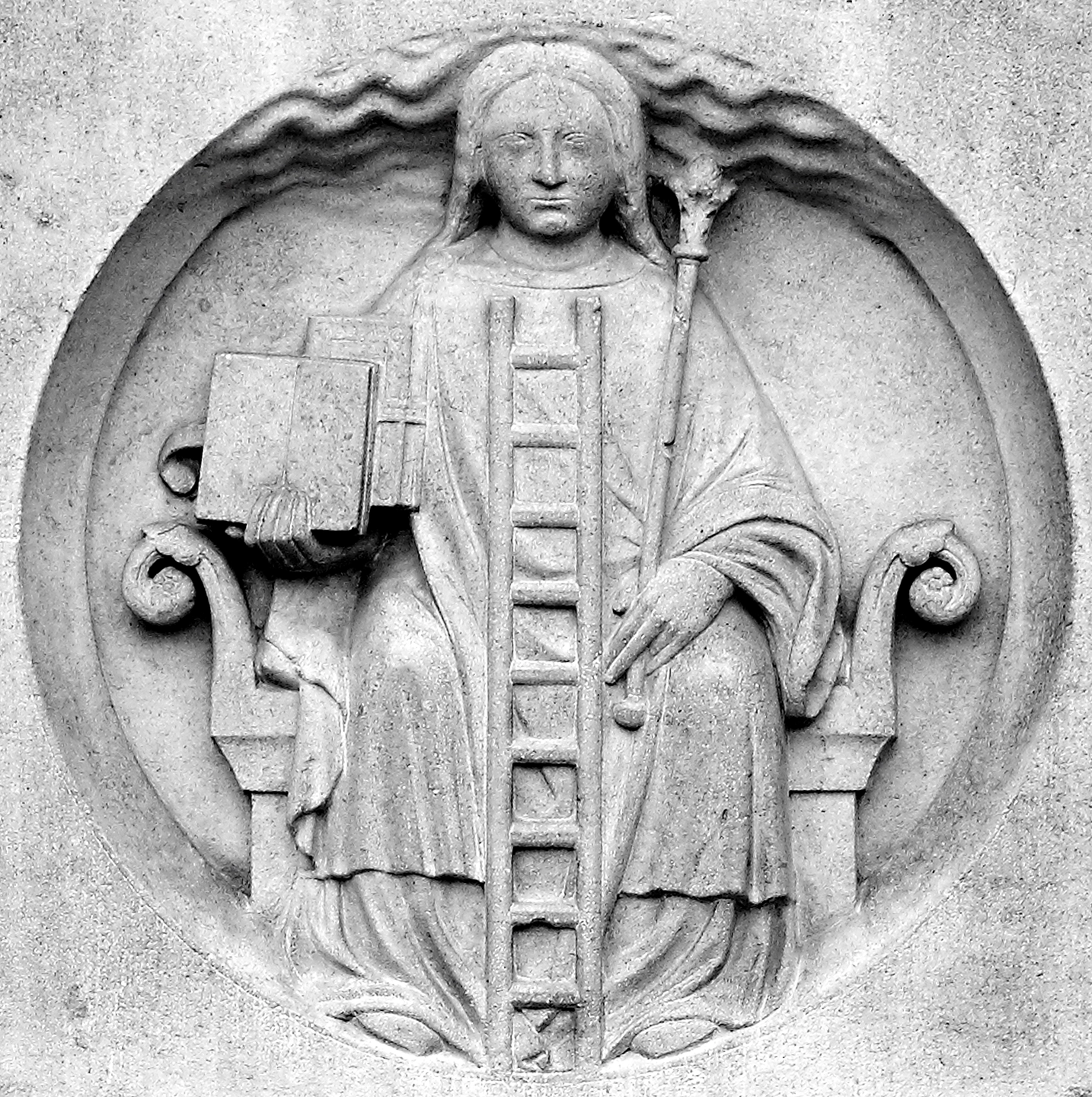
The different states of matter could thus be
compared to the rungs of a ladder, where the matricial
Force crystallizes, or gradually condenses, into more or less regular forms.
This state of affairs is corroborated by one of the most accurate definitions
of alchemy, that of Fulcanelli: “Alchemy is the
permutation of form by light, fire, or spirit.”
Even if, according to the testimony of Eirenaeus Philalethes
(1628–1665), metallic transmutation is a reality, it is important to emphasize
that making gold for the sake of enrichment has never been the goal of alchemy.
Here again, many have gone astray by failing to understand the Kabbalistic
writings of our predecessors. To separate the pure from the impure is to move
from a base matter to a rectified one. The more molecular arrangements become
simple and ordered, the more matter and the matricial
source gradually tend toward reunification, toward Unity. Matter purifies
itself in a revolution inverse to the Luciferian fall (Lucifer means “light-bearer”
in Latin; this name appears for the first time in Greek mythology, where it
designates the guardian of the horses of the solar god Apollo), hence the
Nietzschean concept of the eternal return. The famous immortality, about which
dreamers fantasize so much, is perhaps, in the end, only the search for
eternity, for absolute immobility, where the Eternal rests, closest to Unity.
The realm of the science of the adepts is,
therefore, by definition, outside of time and space. Furthermore, unlike modern
science, which concerns itself exclusively with matter, alchemy, magic, and
astrology focus directly on the matrix and the invisible laws that animate it.
· Astrology
gauges the energetic variations of the ‘celestial fire’ by observing the
influences of stars and planets upon the terrestrial world.
· Alchemy
represents the manifestation of this fire within organisms that are a priori
inanimate (minerals and plants).
· Magic
directly channels this fire into the body of the adept. The latter, as a magus
in the noble sense of the term, possesses perfect mastery of the ‘cosmic fire’.
He succeeds in having this force transit through the energetic centers (or
chakras) of his body in order to modulate and redirect it according to the use
he wishes to make of it. If divine love fills his heart, he will practice white
magic, aiming to create harmony and well-being. Conversely, if he allows
himself to be seduced by the darkness, he will sink into black magic, using
this force to sow division and destruction.
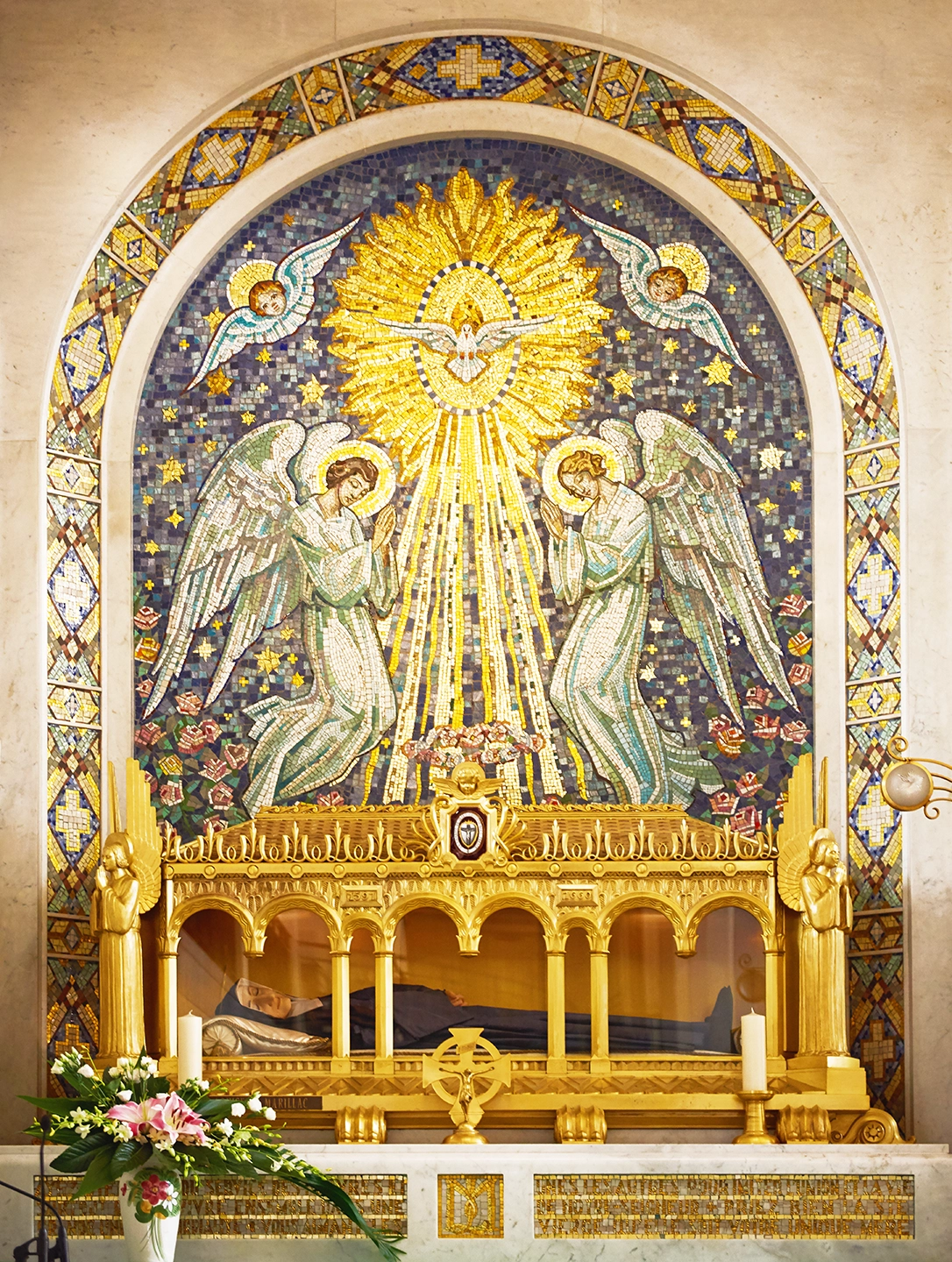
On the horizon of our reflections, it appears
that the driving principle of all existence – the Force underlying life – is
generated by a matrix that finds its origin outside the boundaries of our
reality. A deduction shared by Niels Bohr (1885–1962), Nobel laureate in
physics, when he declared in 1922: “Everything we call real is made of
things that cannot be regarded as real.”
From then on, if the matricial
spirit resides outside the sensible and measurable field, how is it possible to
perceive its essence in the world accessible to men?
•••••
In my view, if this creative Force is the
cause of tangible effects, its signature must necessarily be observable in
nature. It should therefore be possible to glimpse the mechanisms of this
matrix by adopting the mindset of an insatiable curious person – that is to
say, by opening one’s eyes wide. To satisfy this drive, specializing in a
restricted field would be a grave error: the natural philosopher must open the
field of possibilities to all disciplines, from astronomy to mineralogy; in
other words, to all phenomena visible between heaven and earth. The imprint of
the Force must be present everywhere, and as the Emerald Tablet suggests, in
the infinitely large as in the infinitely small. The work consists of spotting
its traces, then finding the analogies that link them.
It was while working on this task that, in
the 13th century of the Christian era, the mathematician Leonardo Fibonacci (c.
1170–1245) noticed that an arithmetic sequence was linked to generation in the
biological world. In the progression of this sequence, each new number is the
sum of the two that precede it, namely: 0, 1, 1, 2, 3, 5, 8,
13, 21, 34, 55, 89, 144... and so on. The higher the numbers become,
the more the ratio between a number and the one preceding it tends toward a
mathematical constant with a value of 1.618. This proportion was defined by the
father of Greek geometry, Euclid, as the division of a segment in “extreme and
mean ratio.” This proportion, which we find in the phyllotaxis of the plant
world, seems to be a universal model, repeating itself invariably in all of
Mother Nature’s creatures.

We thus observe spiral arrangements of this
numerical matrix in flowers, Romanesco broccoli, and pinecones, but also in the
shells of nautiluses and gastropods. These analogies are staggering, for they
are not limited to these few examples; they find a universal echo in the 3
kingdoms of the living world: mineral, vegetable, and animal. Nature performs
geometry automatically, without a square or compass. Nature has no need for a
blueprint: it is the blueprint. Its architecture, especially when
expressed in a helical (let us recall that “helical” and “helix” share the same
etymological root as Helios, the Greek solar god) and logarithmic
manner, is simply dazzling. I will never understand why most of us remain
unmoved before such beauty and elegance. Do they not have eyes to see?
Since the 20th century and the work of Matila
Ghyka (1881–1965), the ratio of 1.618 is commonly
called the “nombre d’or” (golden
number). “golden number.” Using this term would
nevertheless be a conceptual error, for a proportion is not a number, but the
relationship between two magnitudes in an arithmetic or geometric expression.
It is therefore preferable to use the term “golden proportion” rather than “golden
number.”
The etymology of the word “or”
(gold) proceeds from the roots aor, aour, aur, or our in Semitic
languages, which all translate as “light.” Remembering the prologue of the
Gospel according to Saint John, where it is written: “The Word was God (...)
The Word was the true light,” the correlation between God, the Word, light,
and the golden proportion becomes manifest for one of
the modes of thought of the magi: synonymic reasoning. If you were looking for
concrete proof of the existence of God, the golden proportion would lend your
argumentation a factual dimension difficult to refute. Especially since the
Greek symbol for this proportion, Φ (phi), defined for the early
Christians “the Force of God,” “the will” – the Telesma
of the Emerald Tablet – or the principle of the concentration of the Spirit
into matter.
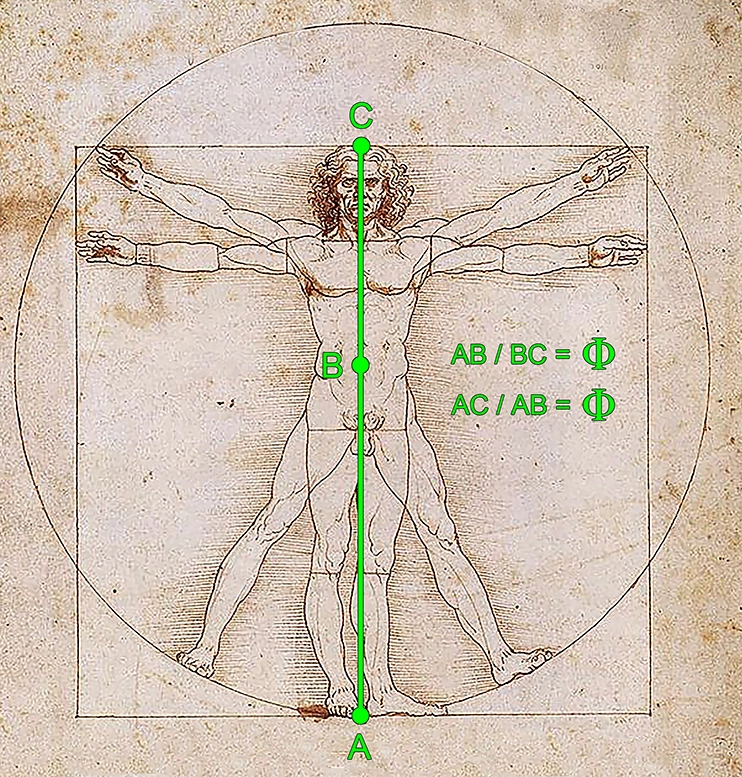
The signature of Φ also manifests in
human anatomy. Among the multitude of examples we could cite, that of the “nombril”
(the navel) is the most significant. Indeed, knowing that the word nombril
is the phonetic homologue of nombre-el,
Kabbalists would decompose it into “nombre”
(number) and “el” to extract the substantive marrow.
As El is the name of God at the origins of humanity, this point, so
central in Vitruvian Man, is the physical revelation of the divine signature
within the proportions of the human body. On one hand, it is through this place
that the mother’s nourishing energy was breathed into us; on the other – and
this is why it interests us here – it divides, on average, the distance between
the feet and the top of the head according to the golden proportion. Verse 1:27
of Genesis, which declares that “man was made in the image of God,” is
therefore not a parable: it must be understood literally, at the first degree.
The Larousse dictionary explains that:
“Φ is the
21st letter of the Greek alphabet (21=3x7),
corresponding in ancient Greek to an aspirated [p] and, in modern Greek, to an
[f]. It is transposed by [ph] in French words derived
from Greek.” The first syllable of the words “philosophy,” “physics,”
“phyllotaxis,” “firmament,” “force,” and “fire” underscores the intimate
relationship these terms maintain with the golden proportion. Etymology is a
science to be handled with the utmost seriousness, for, as you have been able
to realize, the investigation keys offered by this tool are unparalleled.
Given all these
sympathies, it seems hardly presumptuous to assert that Φ, the true
swirling pivot of universal harmony – to be understood as (to be
heard as “uni
vers El” (united toward El)
or “uni
ver sel,” meaning
“united green salt” in a right-to-left reading), is the organic imprint of a creative matrix whose structure is subject
to the laws of geometry and arithmetic. Plato (c. 428–347 BC) understood this
very well when he declared: “God
eternally geometrizes,” and: “Geometry draws the soul toward truth and
creates the philosophic mind, by forcing the soul to turn its gaze upward,
rather than casting it downward.”
For their part, historians tell us that the
golden proportion was christened “phi” to honor the sculptor Phidias (c.
480–430 BC), famous for his work on the decoration of the Parthenon in Athens,
where this precious ratio is exalted in the proportions of the façade. Should
we be astonished that the golden proportion was already being used five
centuries before the Christian era by Greek architects, but also, according to
the work of René Adolphe Schwaller de Lubicz
(1887–1961), by their Egyptian counterparts? Absolutely not, for all Artists,
worthy of the capital letter, have always strived to make their works resonate
with this specific signature. In their desire to mimic (“singer” in French, to be heard “saint G” (Holy G), where G is a graphic representation of
the spiral), they attributed to Φ
the ultimate canon of beauty. Every time Φ
is used, it is a syncretic homage to nature and the Creator that is being
celebrated. From the grandiose pyramids of the Giza plateau to the paintings of
Wassily Kandinsky (1866–1944), Φ
has always been the preserve of artistic genius and the mark of a symbiotic
relationship with the universe. This form of expression was surely born of a
necessity: that of revealing and glorifying, within the material world, the
invisible intelligence of the Divine Creation.

To the dismay of our contemporaries, Art
before the 20th century had nothing in common with the “works” of today. The
word “art” has become, despite itself, a catch-all term in which any plastic
creation can find a place. It suffices to visit today’s galleries to realize
that what is now called “art” has become an intellectual masquerade and a
visual pollution, upon which ill-intentioned people or charlatans attempt to
make a fortune. As early as 1973, Jean Phaure
(1928–2002) described this movement with implacable lucidity: “Modern art is
a black magic, sometimes in the most operative sense of the term, and its
eschatological function, like that of psychoanalysis, is to return to the field
of our consciousness our infra-psychism, populated by all the psychic and
demonic residues that had, in previous phases of the cycle, been contained in
these cellars by sacred art, religions, and initiatory knowledge.”
There is no need to hold a doctorate in art
history to realize that creativity is, in comparison with the achievements of
our past, the victim of a commanded process of destruction. Indeed, how can one
place on the same pedestal the paintings of Jackson Pollock (1912–1956) and
those of Michelangelo (1475–1564), Raphael (1483–1520), or Botticelli
(1445–1510)?
Unfortunately for the human race, this
imposed form of intellectual terrorism is not limited to the borders of art,
but corrupts all the pillars upon which the emancipation and balance of a
healthy society rest.
To this, it must
be added that a person’s creativity does not necessarily make them an Artist.
The masters are formal on this and are here to testify to it: one does not
become an Artist overnight; perfecting one’s Art requires much labor and an
ascetic spiritual practice at every moment. Without having undergone the
purification and rectification of one’s soul – in short, without demonstrating
holiness – it is practically impossible to receive divine inspiration, to
resonate with the Force, and to become one with the grace of one’s quintessence
in order to produce a true work. Leonardo da Vinci (1452–1519) drives the point
home, addressing those aspirants who are often devoid of talent, by suggesting
that the title of Artist is earned only at the highest level: “The artist, constantly occupied with
contemplating creation, renders a perpetual homage to the Creator. Our study,
so patient, of the divine work requires more effort than chanting matins.”
Art therefore
induces a fusion with the sacred; in this sense, it must be the reflection of
the matrix space. To achieve this, every detail must be maturely reflected
upon, measured, and weighed. Absolutely no element can be the fruit of chance.
As Jean Phaure emphasized, this work is at the
antipodes of spontaneous art: arithmetic proportions and regulatory geometric
traces organize a harmonious and resonant composition, the choice of colors
accords with the symbolism of forms and volumes, and mythological and religious
archetypes mingle with Kabbalistic references of all kinds. Moreover, one must
never forget the hermetic character of the form, according to the adage of the
tradition: “To show, to signify, and
to hide... all at once.” Divinity does not
show... it suggests.
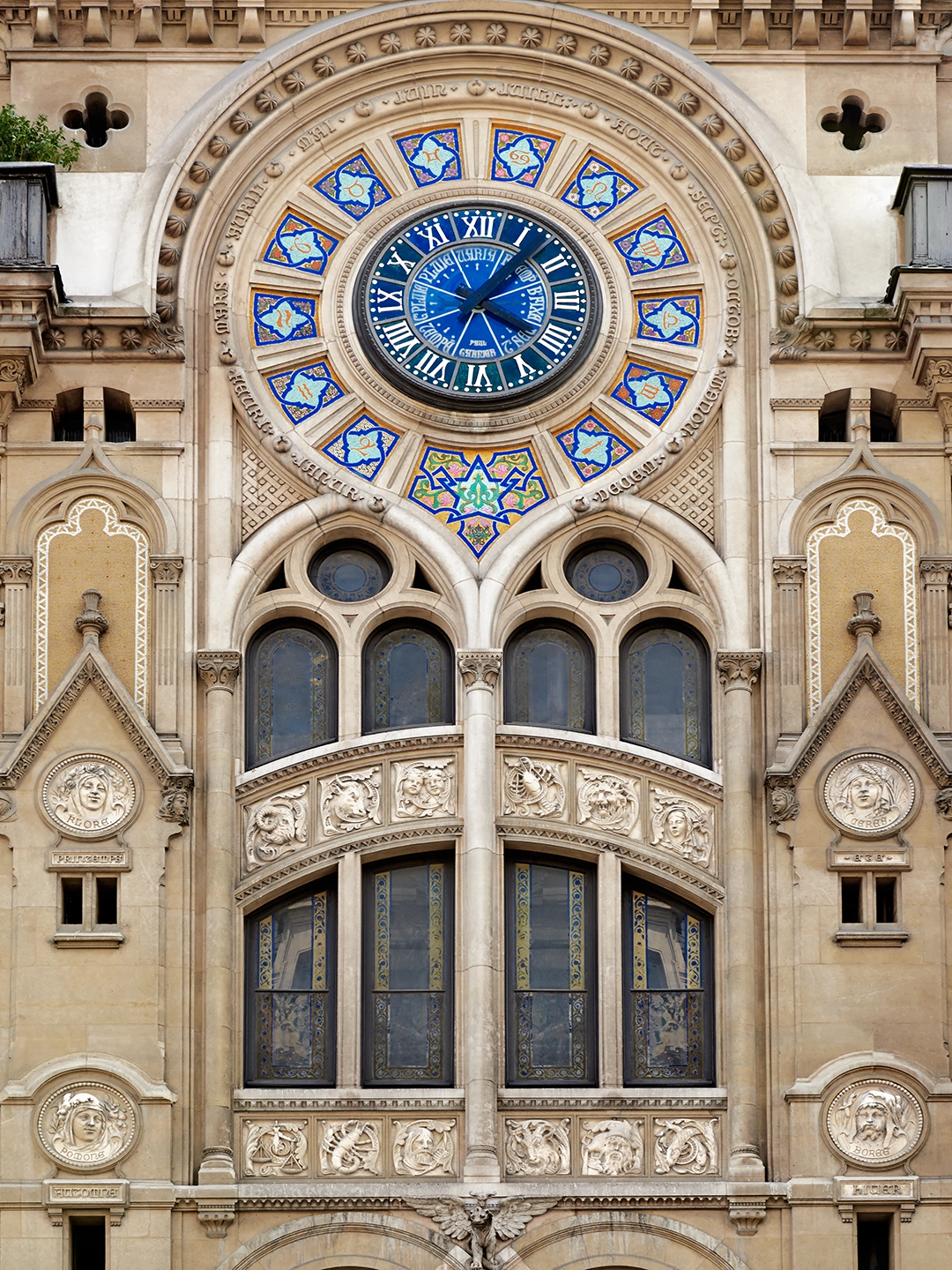
In the higher “magma” of the creative spirit,
and since it is often considered the cornerstone of all arts, architecture
occupies a privileged place in the relationship it maintains with natural
elements. The synchronization between the properties of a temple and temporal
cycles has always been one of the best-kept secrets of the high initiatory
spheres of priestly castes. It is in the resolution of the squaring of the
circle that the building is raised toward the sacred, thus asserting its
operative function by conjugating, within itself, celestial and terrestrial
energies. When a temple is built according to the rules of art, its geometric
form gives the space its orientation and, as a needle would on a sundial, it
also gives the measure of time. In this, the scientific knowledge of cosmic
cycles elevates the architect to the rank of the initiates; it cannot, for this
purpose, be otherwise.
Unfortunately for humanity, few people truly
understand the coding systems employed in the artworks of our ancestors. Even
when certain attempts are crowned with success, the academic doxa
automatically labels them as the work of harmless eccentrics. This label
justifies, in the eyes of the moderns, approaching the arts through the prism
of psychology, for one must attempt to provide an explanation – however
phantasmagorical – for the allegories, metaphors, and parables stemming from
the traditional culture of our masters. Be that as it may, throughout this
thesis, we shall attempt to decipher a few works for what they truly were. In
this perspective, the best way to set about it is to use the tools that have
been bequeathed to us; in this regard, a mastery of the liberal arts is
indispensable.
The liberal arts are seven in number and are
divided into two paths: the Trivium and the Quadrivium.
·
The Trivium
is defined by the expression of the Word (the Light) through words.
·
It is divided
into 3 subjects: grammar, dialectic, and rhetoric.
·
The Quadrivium
relates to the power of numbers, which is the expression of the Word
through mathematics.
It is divided into four subjects: arithmetic,
music, geometry, and astronomy.
Alongside these seven paths, a linguistic
axiom derived from Hermetic Cabale, known as the “Language of the Birds,”
completes the artist’s already well-stocked palette. This slang, described as
solar, whose principles are sanctified in the appearance of its initiator with
the head of an ibis, Djehuty-Thoth, is based
exclusively on the assonance of words, never taking into account the rules of
spelling or grammar. Richard Khaitzine (1947–2013) spoke of it as follows: “This
language of the birds is the one revealed by Jesus to the apostles through his
spirit, the Holy Spirit. Remember this episode taken from the Gospels. It is
the period of Pentecost, and the apostles receive the gift of tongues in the
form of tongues of fire, fire being a synonym for spirit. But in this case, you
may ask, why is it called the language of the birds? Because the Holy Spirit,
being volatile in nature, is frequently symbolized by a volatile creature, a
bird, often a dove.”
With the aim of bridging the weaknesses of
language and providing the final keys essential for opening the closed realm of
the mages, the disciple of Hermes will utilize another vector of transmission,
still very poorly understood today: the symbol.
•••••
The symbol plays a more than singular role:
by stimulating the psyche alone, this figurative sign connects man to his
imagination and links his thought to spheres indescribable by words. Indeed,
the sound of a word is a vibration that the ear can hear; in this state, it
already possesses a material manifestation. The word thus clumsily cuts the
dynamics of the idea it wishes to define; it is precisely to remedy this
weakness that the use of the symbol demonstrates its full effectiveness. By
creating a bridge between the created and the uncreated, this mode of reading
gives the mind the possibility to cross the mirror of appearances, to glimpse
behind the curtain, outside of space and time. Ferdinand Brunetière (1849–1906)
specified: “The symbol is image, it is thought… It makes us grasp, between
the world and ourselves, some of these secret affinities and obscure laws which
may well exceed the reach of science, but which are nonetheless certain; every
symbol is in this sense a kind of revelation.”
We could not conclude this introduction
without honoring, once again, the sharp intellect of René Guénon
(1886–1951), for his life and work alone crystallize a spiritual search devoid
of any concession. In his book Symbols of Sacred Science, he wrote: “We
have already had occasion to speak of the importance of the symbolic form in
the transmission of doctrinal teachings of a traditional order (…)
Why is there so much more or less overt
hostility toward symbolism? Assuredly, because it is a mode of expression that
has become entirely foreign to the modern mentality, and because man is
naturally inclined to be wary of what he does not understand. Symbolism is the
means best adapted to the teaching of truths of a higher order—religious and
metaphysical—that is to say, everything that the modern mind rejects or
neglects; it is the very antithesis of what suits rationalism, and all its
adversaries behave, some unknowingly, as true rationalists (…)
Thus, the highest truths, which would be in
no way communicable or transmissible by any other means, become so to a certain
point when they are, so to speak, incorporated into symbols that will
undoubtedly hide them from many, but which will manifest them in all their
splendor to the eyes of those who know how to see (…)
If the Word is thought inwardly and speech
outwardly, if the world is the effect of the divine Word uttered at the
beginning of time, all of nature can be taken as a symbol of supernatural
reality. Everything that exists, in whatever mode, having its principle in the
divine intellect, translates or represents this principle in its own way and
according to its order of existence; and thus, from one order to the other, all
things are linked and correspond to one another, concurring in the universal
and total harmony, which is like a reflection of the divine trinity itself.
This correspondence is the true foundation of symbolism, and that is why the
laws of a lower domain can always be taken to symbolize the realities of a
higher order, where they have their profound reason, which is at once their
principle and their end.”
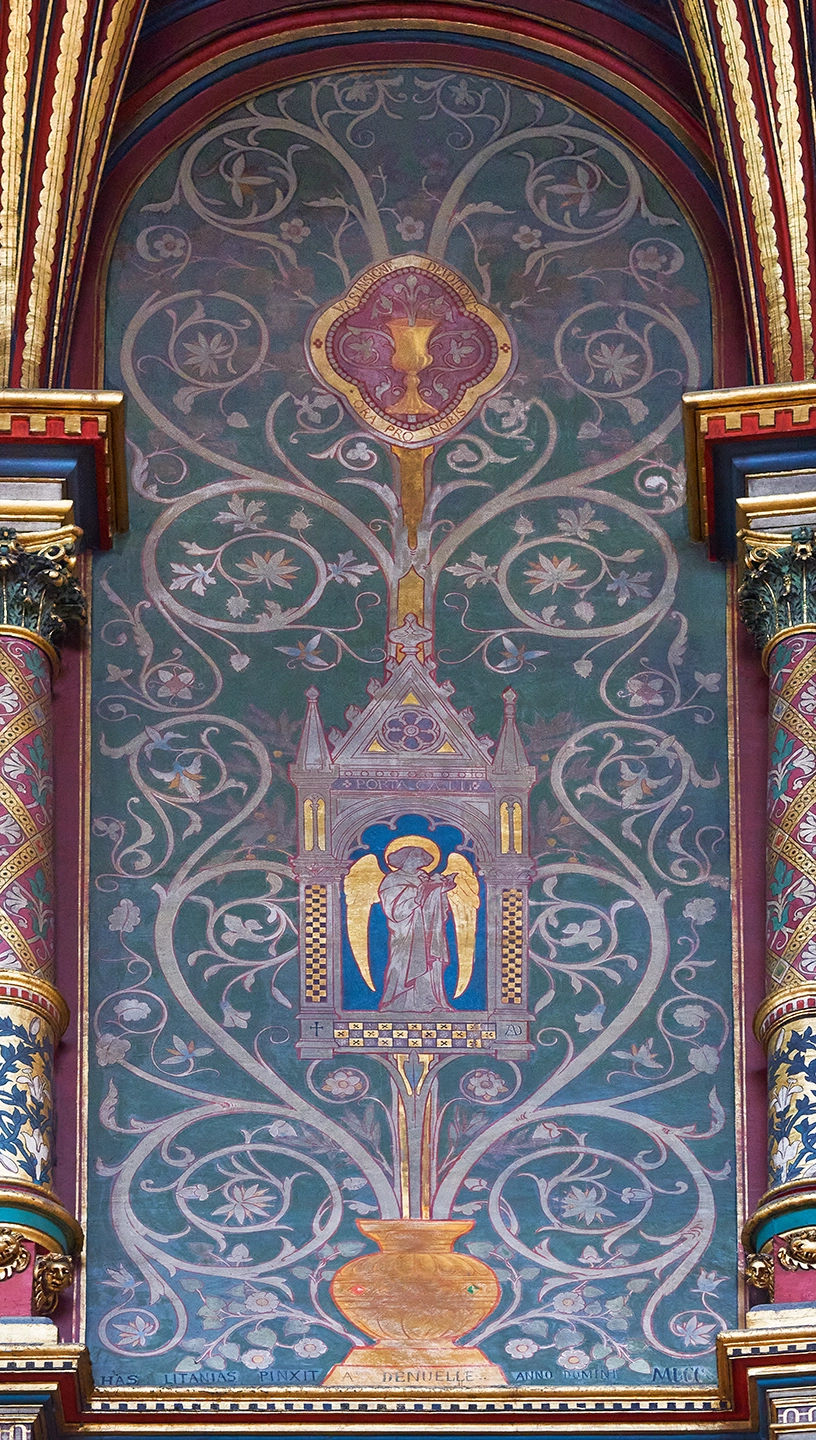
In its vulgar representation, “saint bol” (holy cup) takes the form of a cup or a
chalice. During the magical ritual of the Mass, at the moment of the
Eucharistic sacrament, it gathers the Christic blood,
a metaphorical liquid of cosmic fluid. The evocation of an aqueous essence
inevitably recalls how the Hermetists associated the
behavior of the mercurial spirit with a primordial ocean. Following this
analogical reasoning, the symbol fulfills the exact same function as its
homophone, revealed by the “Language of the Birds”: the “saint bol” (holy cup) is the receptacle and the revealer,
in the tangible world, of the ineffable principles of the universal matrix.
I understand that,
for most of you, Hermeticism may appear quite mysterious, or even chimerical,
especially since this philosophical current proposes historical and scientific
perspectives that mainstream thought qualifies as irrational. I can already hear
the rhetoric of the most indoctrinated: “How could the man of Antiquity know what modern science is only just
beginning to glimpse? Are we not superior to those hicks of the past?”
Indeed, whether he likes it or not, modern
man is unaware of his own ignorance. However, one should not cast stones at
him: from kindergarten to university lecture halls, he is driven to naively
repeat what he is taught. Since the majority have grown up within this same
system, it is only logical that “normal” individuals are all formatted
according to the same model. In his defense, it must be acknowledged that the
pursuit of knowledge and intellectual enrichment are no longer valued
activities. Absolutely nothing is organized to encourage us to frequent
libraries or to broaden our understanding. This sad reality is the inexorable
consequence of a national education system constantly leveled downwards, the
propagation of a culture of the artificial to the detriment of the natural, the
promotion of mediocrity by mainstream media, and the stupefaction of the masses
through the hypnotic manipulation of television. Above all, it is the result of
the growing denial of a spiritual, transcendent, and salvific realm. It is a
fact: there is no shortage of intellectuals who take pride in their own
agnosticism… How tragic!
At the dawn of the 21st century, the collapse
of thought mirrors the decadence, degeneration, and decay of our civilization.
This intellectual sclerosis has become an increasingly thorny obstacle for
those who walk the paths of spiritual evolution, personal emancipation, or the
Gnostic way. Social conditioning is so powerful that the intrepid – those who
still dare to think for themselves – are often ostracized by society, when they
are not subjected to mockery. It requires tremendous strength of character to
free oneself from the wrath of the masses and the judgment of others. This work
demands a deep and delicate introspection; very few are prepared to consent to
the suffering necessary to dissolve the illusions of daily life and break free
from them. Being capable of emptying one’s chalice of all its impurities, in
order to refill it with a more radiant light, remains an accomplishment
inaccessible to most of us.
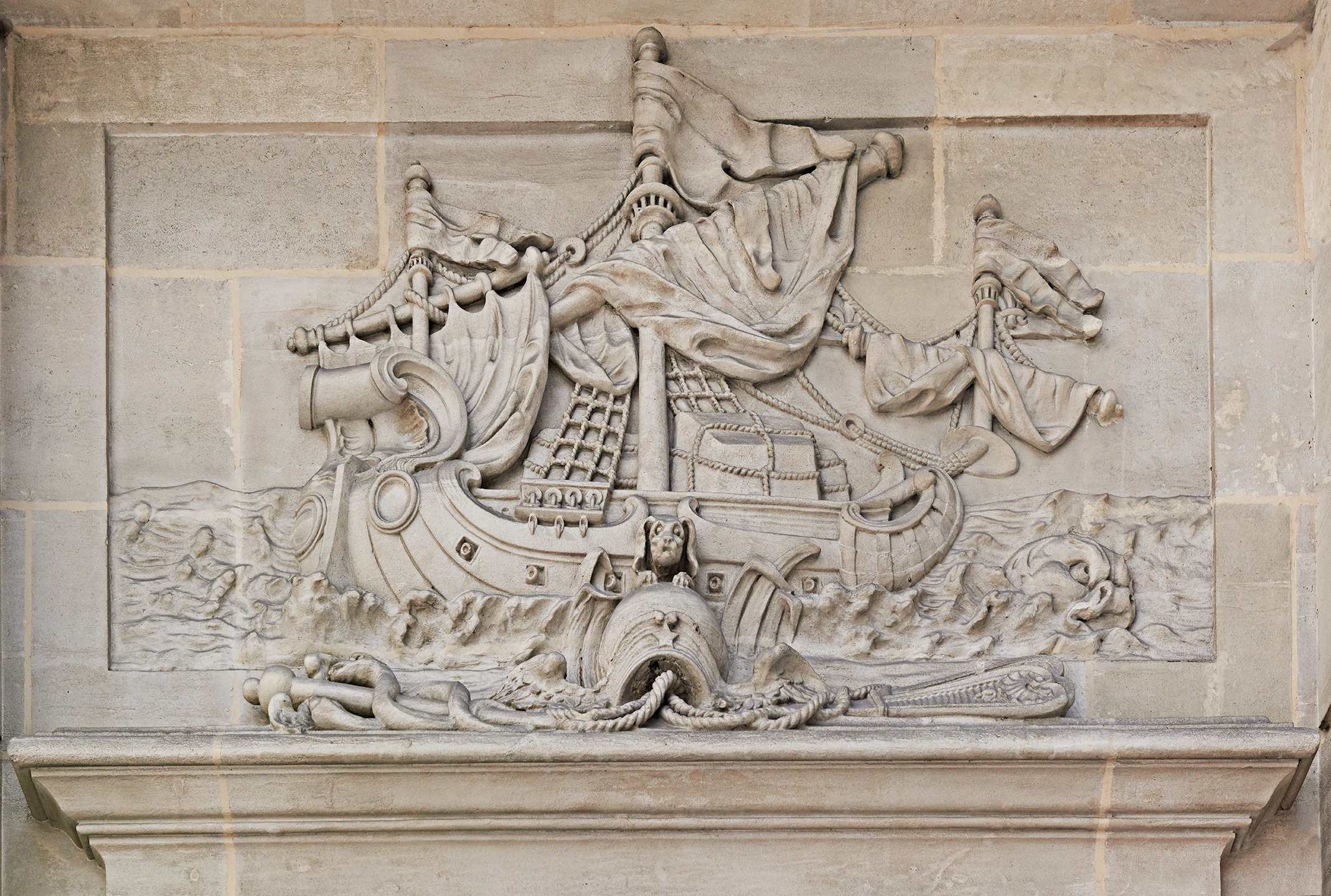
Prudence, temperance, fortitude, and justice
are the cardinal virtues necessary for the opening of the kingdom of God. If
perseverance is our loyal servant on the path of truth, the vertical essence of
solar fire will illuminate our hearts, and the work undertaken will always be
crowned with success. Without this spiritual quest, I would probably never have
found the courage to share these few lines with you, for the metaphysical
currents upon which the winds of this demonstration will carry us are ridiculed
by the orthodoxy of our educational system and remain unknown to today’s
globalized culture. This thesis could never have become an original stone added
to the edifice if our habitual prejudices had not been overcome, if the
frontiers of the unexplored had not been pushed back, and if our reality had
not been transcended.
To achieve this, the scientific and syncretic
study of the main religious symbols will constitute the major axis around which
this thesis will evolve—its axis mundi. Like a modern Jason in search of
the Golden Fleece, guided by the clarity of the Pole Star, we will navigate the
most mystical and unexplored vibrational oceans. I therefore invite you to
explore sacred science aboard my vessel, to lift the veil on the natura naturans of the Holy Spirit, and to cast off towards
the most absolute mystery of all: the creation of space-time.
Ludovic
Nicolas